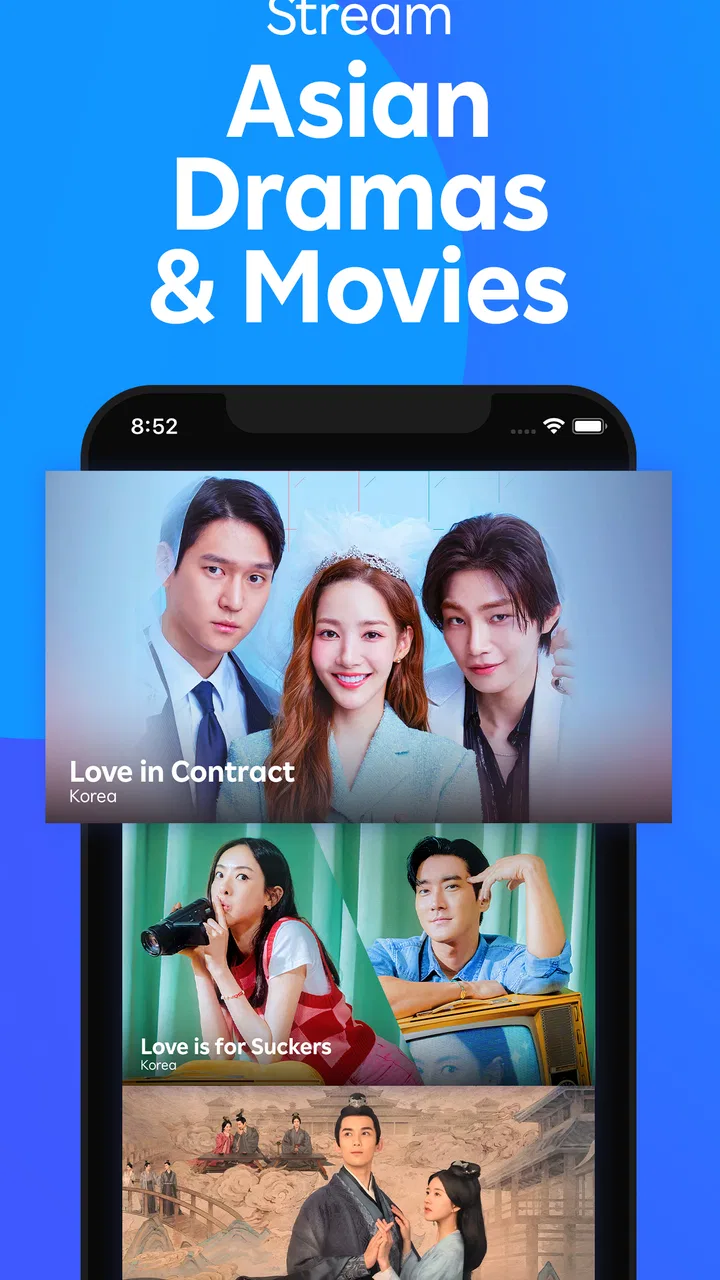
Viki: Asian Dramas & Movies
- 4.7
- Rating
- 100.00M
- Installs
- Free
- Price

 Analysis by App-foxy
I reach for Viki: Asian Dramas & Movies when I want entertainment that is centered on Asian television and film rather than a broad service where those titles are mixed into everything else. It is a free entertainment app from Viki, Inc., built around Korean dramas, Chinese dramas, Japanese shows, movies, and variety programs. That focus makes the decision fairly simple: if those are the kinds of stories you actively search for, Viki feels purposeful; if you mainly want a general streaming library, another service may be easier.
My overall impression is positive, but not blindly enthusiastic. The app gives fans a convenient place to browse a large Asian-focused catalog, and its strong community response reflects that appeal: it holds a 4.7 average from around 1.1 million ratings, with more than 100 million installs. At the same time, the free entry point does not mean every viewing experience is equally smooth. Advertising, availability differences, and optional purchases are part of the practical decision, so I would choose it for its content identity first, not simply because it costs nothing to install.
How I Decide Whether Viki Is the Right Streaming App
Before installing it, I would ask myself three questions. Do I regularly watch Korean, Chinese, or Japanese content? Am I comfortable using a service whose strongest advantage is specialization rather than an all-purpose catalog? And do I want to start watching for free, while accepting that some parts of the experience may be shaped by advertising or paid options?
In-Depth Coverage of Viki: Asian Dramas & Movies
Those questions matter more than the app’s general entertainment label. Viki is not trying to be a little bit of everything. Its store summary points directly toward KDrama, Chinese drama, Japanese shows, movies, and variety shows, and that concentration is what gives it character. I found the app more useful when I approached it as a destination for a particular viewing habit rather than as a replacement for every streaming app on my phone.
The age classification is Teen, which is a useful reminder that the catalog is aimed at a broad audience but is not automatically children’s entertainment. Parents should still look at individual titles before handing over the device. For ordinary adult or teen viewing, the rating gives a reasonable high-level expectation, but it should not be treated as a guarantee that every show has the same tone or themes.
What I look for during everyday use
My first test with a specialized streaming app is how quickly it helps me find something I actually want to watch. With Viki, the most natural workflow is to begin with a country, genre, or familiar type of show, then narrow my choice by mood. That is more comfortable for a fan of Asian entertainment than opening a general service and repeatedly searching through recommendations that may prioritize unrelated content.
I also pay attention to whether the app works for different viewing situations. A focused drama platform should be useful for a planned evening watch, a short break with a variety episode, and the moment when I remember a title but not its exact name. Viki fits those situations best when I already know the kind of content I want. It is less convincing when I am simply bored and expect an algorithm to surprise me with something from every possible category.
One practical tip is to treat browsing as part of the experience instead of expecting the first screen to make the decision for you. I would spend a few minutes checking several categories before committing to a long series. That small habit reduces the chance of starting a show only because its thumbnail looked appealing, then discovering that its pacing or format is not what I wanted.
Why the specialized catalog changes the decision
Viki’s biggest strength is not merely that it includes Asian titles. It is that the entire service is organized around viewers who are already interested in them. That changes the value of the app. A person looking for a Korean romance, a Chinese historical drama, a Japanese series, or an Asian variety program is likely to feel less distracted than on a general platform.
For me, this specialization also makes it easier to build a viewing routine. I can use one app for a focused drama night, then switch to a lighter variety show without leaving the same general entertainment space. That is a more coherent experience than jumping between unrelated services just to follow different parts of the same interest.
There is a trade-off, though. A focused catalog can feel narrow to someone whose taste changes constantly. If one evening I want a mainstream action film, a documentary, and a sitcom from different countries, Viki may not be the most efficient single destination. Its value rises with the percentage of my viewing that belongs to its core categories.
Where Viki Wins, and Where Another App May Fit Better
I find the strongest case for Viki is that it gives Asian dramas and shows a clear home instead of treating them as a small part of a broad catalog. I would compare it with another app only after checking which one better fits the titles and viewing habits I actually have. That choice also depends on how much variety I want from one service.
The strongest case for choosing Viki
I would recommend Viki first to someone who keeps a watchlist of Asian dramas or regularly asks friends what Korean, Chinese, or Japanese show to start next. The app’s identity is immediately understandable, and that saves time. Instead of treating Asian content as a small corner of a huge service, it places that interest at the center.
It is also a sensible starting point for a viewer who wants to explore beyond one familiar country. Someone who began with KDrama can use the same app to try Chinese drama, Japanese shows, movies, or variety programming. I like that progression because it feels natural: the user can move sideways into related formats without having to learn an entirely different service.
Another advantage is the free starting point. I can install the app without making an upfront payment and decide whether its catalog and viewing style suit me. That lowers the risk for casual viewers. It is especially helpful if I am curious about a particular title but do not yet know whether I will become a regular user.
You May Also Like

 AccuWeather: Weather Radar
AccuWeather Review: A Quick, Clear Forecast for Everyday Decisions
For everyday plans, the best forecast is the one you can understand quickly. AccuWeather makes rain timing, radar, and local conditions easy to act on, with a few trade-offs.

 Hill Climb Racing
Why Hill Climb Racing Still Turns Crashes Into One More Run
A tiny car, a bumpy hill and one more upgrade: Hill Climb Racing keeps resurfacing because its simple chaos makes every near-miss feel personal.

 AliExpress - Shopping App
AliExpress Makes Global Shopping Feel Personal, but Shoppers Bear the Risk
AliExpress turns a global marketplace into a pocket-sized discovery engine. Its reach is useful, its shopping loop compelling, and its trade-offs easy to miss.

 PDF Scanner app - TapScanner
TapScanner Makes Paperwork Easier to Capture, Check, and Share
TapScanner makes scanning with a phone feel less like a rescue operation and more like a dependable step in getting work done. Its capture tools are useful, though not flawless.

 Block Blast!
 Shows How Much a Puzzle Game Can Leave Out
A quiet grid game shows why puzzle players increasingly value instant clarity, repeatable skill and low-pressure play—and where the genre still needs to catch up.

 Family Space
 Review: A Shared Routine That Makes Family Life Easier
A parenting app earns its place not by adding more noise, but by making everyday coordination easier. Family Space gets that balance mostly right.
More From Our News Desk
View All News


The app has been available since March 4, 2012, and its current version is 26.1.0. Those details suggest a long-running product rather than a short-lived experiment. In practical terms, I would expect an established viewing environment, although the quality of any individual session still depends on the title, device, connection, and how the service presents that content at the time I use it.
Small habits that make the experience better
My first useful habit would be to choose a series with enough time for a proper trial rather than judging the entire service from a few minutes of one episode. Drama pacing can differ significantly from the faster rhythm of many mainstream shows. Giving a title a fair chance helps separate “this app is not for me” from “this particular show is not for me.”
My second tip is to use Viki as a discovery tool even when I watch elsewhere. If I am deciding whether Asian entertainment deserves more space in my routine, browsing its categories can help me identify formats and countries I had previously ignored. I would then compare the actual viewing experience and availability with my other services before committing to a long-term subscription or purchase.
A third, less obvious trade-off is attention management. A drama-focused app can make it easy to begin one more episode because the next choice is always close at hand. I would set a stopping point before starting a late-night session, particularly with long-form series. This is not a flaw unique to Viki, but the concentrated catalog makes it especially easy to remain in one viewing mood for hours.
When a general streaming service is the better choice
I would lean toward a general streaming alternative if my household needs a wide mixture of content in one place. A family with very different tastes may prefer a service that combines children’s programming, major films, documentaries, sports, and international shows, even if its Asian selection is less focused. The convenience of one broad catalog can outweigh Viki’s specialization.
I would also consider another option if I mainly watch titles from a single provider or follow a specific release pattern that Viki does not cover for my region. Availability can influence the decision more than the app interface. Before beginning a long series, I would check whether the title I care about is accessible where I live and whether the viewing conditions suit me.
Someone who dislikes advertising should be especially careful. The free model is attractive, but free access can involve interruptions or limits that a paid service handles differently. I would not install Viki expecting the same uninterrupted routine I might associate with a premium subscription elsewhere. The right comparison is not simply free versus paid; it is focused catalog plus free access versus broader catalog plus a different payment experience.
There is also a case for using more than one service. Viki can be the specialist app, while a broader platform handles everything outside Asian entertainment. That arrangement costs more attention and possibly more money, but it may be more realistic for a committed viewer than forcing one service to satisfy every preference.
What the free model really means for a regular viewer
Viki is free to download, which makes trying it straightforward. However, in-app purchases range from $0.99 to $119.99 per item. I would therefore avoid assuming that every useful option or every preferred way to watch is included at no cost. The sensible approach is to begin with the free experience, identify what I actually use, and only then decide whether any purchase is worthwhile.
That order matters because occasional viewers and dedicated fans have different needs. If I watch one episode now and then, paying may not make sense. If I use the app as my main source of Asian entertainment, optional spending may become easier to justify, but I would still compare the total cost with a competing service before buying anything. A low individual purchase can feel harmless while repeated choices quietly become expensive.
My advice is to treat payment as a solution to a specific annoyance, not as an automatic upgrade. If the free experience already gives me the shows and schedule I want, I can stay with it. If interruptions or access conditions repeatedly interfere with viewing, I should compare the available paid route with other services rather than paying out of habit.
Device compatibility and the practical setup
The app requires at least OS 9, so I would check the operating system before downloading it to an older phone or tablet. That requirement is modest for many current devices, but older hardware can still affect loading, battery use, and general comfort. A larger screen is preferable for subtitled dramas, especially during long episodes, while a phone is more convenient for short viewing sessions.
I would also prepare for the possibility that subtitles demand more attention than dubbed content. That makes screen brightness, comfortable text size, and a stable viewing position more important than they might be for casual background television. In my experience, an app can have a good catalog and still become tiring if I am watching on a small screen with constant distractions.
For a realistic everyday scenario, imagine finishing work and wanting something familiar without spending half an hour browsing. I would open Viki, go directly to the type of drama I have been following, and watch an episode during dinner or later in the evening. On a weekend, I might use the same app differently: browse Japanese shows or variety programs, sample something outside my usual choice, and decide whether it deserves a place in my regular rotation.
The switching cost before you make Viki your main app
Moving to Viki is easy if I am only testing it. The real cost appears when I try to make it my primary entertainment service. I need to adjust to a more focused catalog, learn where my preferred types of shows are organized, and accept that another app may still be necessary for unrelated viewing. That is a manageable change for a specialist fan, but it can feel inconvenient for someone who wants one universal library.
There is also a habit cost. If I already have a carefully arranged routine on another service, switching means rebuilding my shortlist and deciding where future shows belong. I would not move everything at once. I would start with one title or one category that Viki handles especially well, then judge the service after several viewing sessions instead of after installation day.
The same gradual approach helps with purchases. Since the app is free to start and paid items can vary substantially in price, I would first learn how often I use it. A trial period based on real evenings, not just enthusiastic browsing, gives a better answer than impulse spending.
My recommendation for different kinds of viewers
I recommend Viki to dedicated fans of Korean dramas, Chinese dramas, Japanese shows, Asian movies, and variety content who want a specialized place to browse. I also recommend it to curious newcomers who want to explore that world without paying before they know whether it fits their taste. Its focus is clear, its free entry point is useful, and its large audience shows that it has become a familiar choice for many viewers.
I would recommend caution to households searching for one app that covers every entertainment need. Viki can complement a broad streaming service, but I would not select it solely because it is free. The more important question is whether its catalog matches what I actually watch. If the answer is yes, the specialization feels like an advantage rather than a limitation.
I would skip it if Asian entertainment is only an occasional curiosity and I already have a general service that satisfies those rare requests. I would also look elsewhere if advertising, optional purchases, or a narrower catalog would frustrate me more than the focused selection would help.
My final view is that Viki works best as a deliberate choice, not a default streaming replacement. I like it because it puts Asian dramas, films, shows, and variety programming at the center and lets me explore that range from a free starting point. The smartest way to use it is to test a few categories, watch long enough to understand the experience, and compare the cost and availability with the services I already use. For the right viewer, the specialization is the reason to install it; for everyone else, that same focus may be the reason to pass.
FAQs for Viki: Asian Dramas & Movies
01What is Viki: Asian Dramas & Movies?
Viki: Asian Dramas & Movies is a streaming platform that offers a wide range of Asian dramas, movies, and TV shows. It features content from Korea, China, Taiwan, Japan, and more. Users can enjoy subtitles in multiple languages, making it accessible to a global audience. The app is available for both Android and iOS.
02Is Viki free to use, or does it require a subscription?
Viki offers both free and subscription-based options. With a free account, users can access a limited selection of content with ads. For an ad-free experience and access to exclusive shows and HD streaming, users can subscribe to Viki Pass, which comes in different tiers to suit various preferences.
03What are the main features of Viki: Asian Dramas & Movies?
Key features of Viki include a vast library of Asian dramas and movies, user-generated subtitles in multiple languages, and community-driven discussions and ratings. The app also offers offline viewing and personalized recommendations based on viewing habits. It's designed to enhance user engagement and viewing experience.
04Can I watch Viki content offline?
Yes, Viki allows users with a Viki Pass Plus subscription to download content for offline viewing. This feature is particularly useful for users who want to watch their favorite shows on the go without relying on a constant internet connection. It's available on both Android and iOS devices.
05Are there any regional restrictions on Viki content?
Yes, some content on Viki may be subject to regional restrictions due to licensing agreements. This means certain shows or movies might not be available in all countries. However, Viki is continuously working to expand its library and availability globally. Users can check the app to see what content is accessible in their region.
Pros
- Extensive library of Asian dramas and movies.
- High-quality streaming with minimal buffering.
- User-friendly interface and navigation.
- Subtitles available in multiple languages.
- Offline viewing option available.
Cons
- Ads can be intrusive without subscription.
- Some content is region-locked.
- Occasional subtitle syncing issues.
- Requires a stable internet connection.
- Premium content behind paywall.

Viki: Asian Dramas & Movies
Gallery